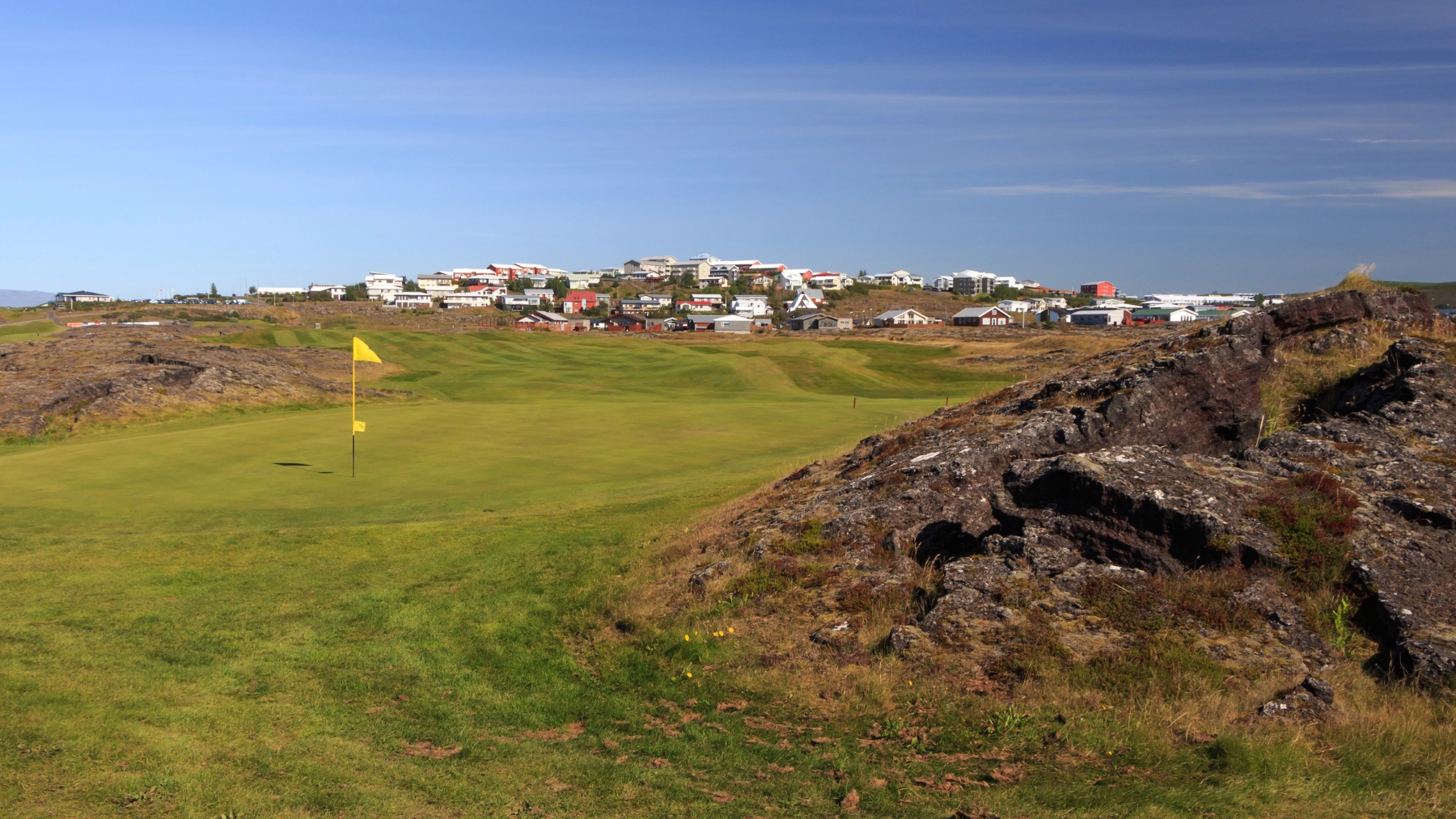
Vestmannaeyjar Golf Club sits on Heimaey, just off the south coast of Iceland, and it is one of those places where the setting is not something that gets added on afterwards, it is the whole point. The course runs through Herjólfsdalur, a wide, green valley that sits inside old volcanic formations, and then out towards the ocean on the back nine. Lava is not something you see from a distance here, it is part of the ground you are playing on, pushing through in places, shaping the edges of holes and sitting right where you would normally expect rough or scrub. The club itself goes back to 1938, which is earlier than you might expect given how remote the place feels, and the current 18-hole course has been in place since the early 1990s. That matters slightly, because this is not a novelty layout thrown together to take advantage of the landscape. It has been developed over time, and you can feel that when you play it. It is still unusual, but it is not random.
What to Expect From The Golf
On paper, the course is a par 70 and not especially long, and if you just looked at the card without seeing the place, you would probably expect something fairly straightforward. That is not how it plays. The front nine sits inside the valley, and that gives it a slightly more contained feel than you expect given where you are. There is still movement in the land, and lava sits in and around a number of holes, but it is not as exposed as what comes later. What it does do is force you to think about where you are placing the ball. The ground is uneven in places, the lies are not always perfect, and if you miss in the wrong spot, you are often dealing with something a bit more awkward than standard rough.
There is a tendency on a course like this to assume that you can just take driver everywhere because it is not long, but that does not really work here. Angles matter more than distance, and being slightly out of position tends to show up pretty quickly when you are trying to play into greens that don’t give you much room to be loose. The back nine shifts the feel of the round quite a lot. You move out of the valley and closer to the ocean, and everything opens up. The wind becomes more of a factor, the views stretch out, and the course starts to feel more exposed. It is not a sudden change, but you notice it.
The 17th is the hole everyone knows, and there is no point trying to downplay it. It is a short par three played over the ocean to a narrow green, and it looks exactly like you think it will. The carry is clean, there is nowhere to hide, and if the wind is doing anything at all, it becomes uncomfortable very quickly. It is not a long hole, but it is not an easy one either, and it is one of those moments where the setting and the golf line up properly. You still have to hit the shot. The important thing is that the course does not rely on that hole alone. There are enough moments across the round where you have to think about what you are doing, and where the land affects the way you play. It is not brutal, and it is not trying to be, but it is not just a walk through a dramatic landscape either.
Conditioning & Presentation
This is not a course that is trying to look perfect in the way a high-end resort course might. It can’t really be, and it shouldn’t be. The ground is uneven, lava sits where it sits, and the weather has a say in how the place looks and plays. What matters is that the surfaces that need to be good are good. Greens are consistent, fairways are solid, and the course is maintained in a way that allows it to play properly without trying to smooth everything out. If anything, it benefits from not being overworked. The rough edges are part of the experience.
Visually, it is one of the more striking courses you will play. The contrast between green fairways, black lava and the Atlantic sitting just beyond is hard to ignore, but it never feels overdone. It is just what the place looks like.
Club & Experience
The club side of Vestmannaeyjar is more understated than the course itself, and that works. This is not a place trying to present itself as a premium destination in the way some courses do. It feels more like a club that happens to sit in a remarkable location rather than one built to capitalise on it. There is a straightforward clubhouse, practice facilities that do what they need to do, and an atmosphere that is relaxed without being flat. You are welcomed, you are pointed in the right direction, and then you are left to get on with it. That balance suits the place. If the experience tried too hard to match the drama of the course, it would probably feel forced. Instead, it stays fairly grounded, which makes the round itself stand out more.
Where It Fits
Vestmannaeyjar is not just another Icelandic course, and it is not something you would casually include on a wider trip without thinking about it. Getting to Heimaey takes a bit of effort, and that is part of the decision. If you are already travelling through Iceland and are willing to make the trip, this becomes one of the more obvious courses to play. It offers something that you are not going to find elsewhere, not just in Iceland, but more broadly. It is not about ticking off a well-known name, it is about playing somewhere that feels completely different.
Final Thoughts
Vestmannaeyjar Golf Club would be easy to dismiss as a course that is all about its setting, and to a point, that is true. The landscape does most of the initial work, and it is what people remember. But the golf is not an afterthought. It is short, but it is not soft. It is unusual, but it is not random. It asks enough of you that you can’t just coast through it taking photos. The 17th will stay with you, but it is not the only reason to be there. The whole round has a slightly different feel to it, and that is what makes it work. It is not trying to be the best course you will ever play, but it is very likely one of the most memorable.